Listen to Article — 7 min
European natural gas prices surged to a three-year high on Monday as geopolitical tensions in the Middle East and rapidly depleting underground storage levels pushed the benchmark TTF futures contract above €45 per megawatt-hour for the first time since December 2021. The rally comes as the continent enters the heating season with gas inventories at their lowest point in 13 years, raising fears of supply shortages and volatile energy costs for households and industrial users. The Price Surge: Ttf Breaks Multi-year Resistance Dutch TTF natural gas futures, the European benchmark, climbed as much as 6.5% in intraday trading before settling near €44.80/MWh. The move marks the highest level since the early days of the energy crisis in late 2021, before Russia’s full-scale invasion of Ukraine tightened global supply dynamics. Key Metric / Asset Current Value / Level Year-on-Year Change Strategic Significance TTF Futures (Dec 2024) €44.80/MWh +85% vs. Dec 2023 3-year high; breaching €45 resistance European Gas Storage Fill Rate 72% (vs. 94% average) -22 percentage points 13-year low for this time of year Brent Crude Oil $82.50/bbl +12% YTD Correlated with LNG shipping costs US Henry Hub Natural Gas $3.15/MMBtu +30% YTD Arbitrage potential for LNG cargoes Storage Levels: a Dire Winter Outlook According to data from Gas Infrastructure Europe (GIE), aggregate storage sites across the EU and UK are only 72% full, compared to a five-year seasonal average of 94%. The shortfall is equivalent to roughly 180 terawatt-hours (TWh) of missing gas - enough to cover the entire heating demand of Germany for two months in a cold winter. Current storage volume: 720 TWh (vs. 900 TWh target) Withdrawal rate: 2.5 TWh/day (accelerating as temperatures drop) Key low-storage countries: Austria (58%), Netherlands (61%), France (67%) Highest storage: Portugal (89%), Spain (85%), Ireland (82%) The depletion is largely attributed to a combination of factors: a colder-than-expected November, reduced LNG imports from Asia due to higher demand, and the lingering effects of the 2022 - 2023 energy crisis that discouraged replenishment during the summer injection season. Geopolitical Flashpoints: Middle East Tensions Add Premium The rally accelerated after reports of escalating hostilities in the Strait of Hormuz, a critical chokepoint for LNG tankers transiting from Qatar and the UAE. A senior trader at a European utility told BeInCrypto under condition of anonymity: “The market is pricing in a potential disruption to Qatari LNG flows. If the Strait closes, Europe loses 15% of its flexible supply. That’s an existential risk when storage is already at 13-year lows.” The situation is compounded by ongoing maintenance at Norwegian gas fields, which typically supply 30% of the EU’s pipeline gas. Norway’s Troll field experienced an unplanned outage last week, adding to the supply squeeze. Market Impact: Crypto Mining and Industrial Users Brace The spike in gas prices has immediate knock-on effects for energy-intensive industries, including cryptocurrency mining. European Bitcoin miners, already struggling with high electricity costs, face further margin compression. A representative from a major Icelandic mining farm stated: “Our power purchase agreements are indexed to the TTF gas price. Every €5 move in gas adds an extra €0.02 per kWh to our operational costs. At current levels, some miners are already operating at negative margins.” The European Bitcoin mining hash rate, which accounts for approximately 5% of the global total, could see a decline of 10 - 15% if TTF prices sustain above €45/MWh, according to industry estimates. Historical Context: Déjà Vu of 2021 The current price level mirrors the autumn of 2021, when TTF futures first breached €40/MWh, heralding the start of the energy crisis. Back then, storage was at 77% - slightly higher than today. The subsequent winter saw prices spike to over €300/MWh in August 2022 after Russia cut pipeline flows. Time Period TTF Price (€/MWh) Storage Level Key Event Oct 2021 €40 77% First window of storage depletion Aug 2022 €342 65% Russia halts Nord Stream 1 Nov 2023 €35 94% Mild winter, ample supply Dec 2024 €45 72% Middle East tensions, low storage What’s Next: Policy Responses and Price Caps EU energy ministers are scheduled to meet in an emergency session on Thursday to discuss potential measures, including a price cap mechanism for gas used in electricity generation and a coordinated LNG procurement strategy. The European Commission has already activated the “Winter Preparedness” protocol, which allows member states to request gas from strategic reserves. The International Energy Agency (IEA) warned that without a rapid acceleration in LNG imports, Europe could face a “severe supply crunch” in January if temperatures drop 2°C below the seasonal average. How Will the Us and Qatar Respond? The United States, the world’s largest LNG exporter, has ramped up output to record levels, with Freeport LNG’s restart adding 2.5 billion cubic feet per day of capacity. However, shipping constraints and Asian demand are limiting the volume available for Europe. Qatar, the other major swing supplier, has signaled it will prioritize long-term contracts over spot sales, potentially exacerbating the shortage. What Are the Risks for Crypto Miners? The energy-intensive nature of proof-of-work mining makes it highly sensitive to gas price volatility. If TTF remains above €50/MWh for two consecutive weeks, analysts at Quantum Commodity Intelligence estimate that roughly 30% of European mining capacity could become economically unviable, leading to a temporary drop in network hash rate and a slower block generation time. When Will Gas Prices Peak? Seasonal models suggest that the peak of the heating season - typically late January - could see TTF prices test the €55 - €60/MWh range if storage continues to drain at the current rate. A prolonged cold spell could push prices even higher, mimicking the 2022 crisis levels. Are There Alternatives to Natural Gas? The EU has accelerated renewable energy installations, but wind and solar are intermittent. Coal - once considered a backup - is now constrained by carbon pricing (EU ETS at €75/tonne) and limited plant availability. Nuclear generation in France has recovered, but only partially offsets the gas deficit. What Does This Mean for the Broader Economy? Higher gas prices directly translate to higher electricity bills for households and industrial users. The European Central Bank has flagged that a sustained energy price spike could reignite inflation, potentially delaying interest rate cuts that markets had anticipated for early 2025. What Happened with European Gas Prices Today? European gas prices hit a three-year high as the TTF benchmark exceeded €45/MWh, driven by Middle East tensions and winter storage levels at a 13-year low of 72% fill. Why Are Gas Storage Levels So Low This Winter? A combination of a colder November, reduced LNG imports, and insufficient summer replenishment following the 2022 crisis has left European storage sites with a 180 TWh deficit compared to the five-year average. How Does Higher Gas Prices Affect Bitcoin Mining? European Bitcoin miners face higher electricity costs as their power purchase agreements are often indexed to gas prices. Sustained TTF prices above €45/MWh could drive 10-15% of regional mining capacity offline. Can Europe Avoid a Gas Shortage This Winter? The EU is holding emergency talks on a price cap and coordinated LNG procurement. However, analysts warn that without rapid LNG imports from the US and Qatar, a severe supply crunch is possible in January if temperatures drop significantly. What Is the Strait of Hormuz’s Role in This Crisis? The Strait of Hormuz is a critical chokepoint for LNG tankers from Qatar and the UAE. Escalating tensions there have added a risk premium to gas prices, as a closure could cut off 15% of Europe’s flexible LNG supply.
Follow Our News on Google
Be instantly informed of developments.
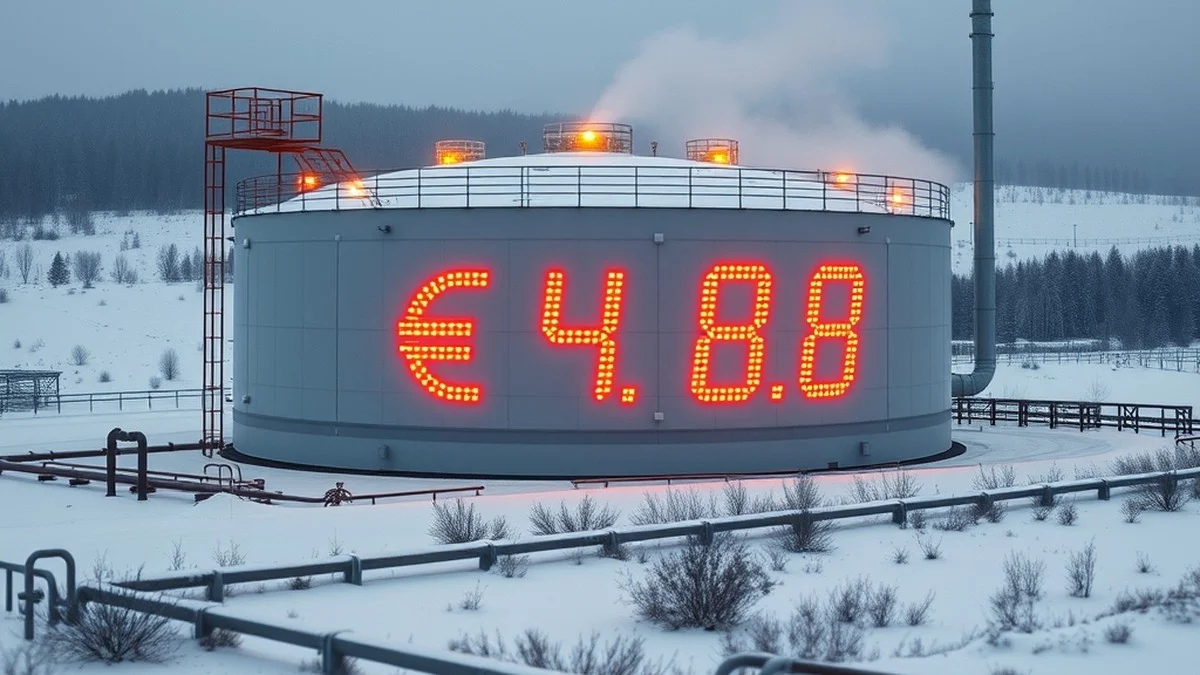
European natural gas prices surged to a three-year high on Monday as geopolitical tensions in the Middle East and rapidly depleting underground storage levels pushed the benchmark TTF futures contract above €45 per megawatt-hour for the first time since December 2021. The rally comes as the continent enters the heating season with gas inventories at their lowest point in 13 years, raising fears of supply shortages and volatile energy costs for households and industrial users.
The Price Surge: Ttf Breaks Multi-year Resistance
Dutch TTF natural gas futures, the European benchmark, climbed as much as 6.5% in intraday trading before settling near €44.80/MWh. The move marks the highest level since the early days of the energy crisis in late 2021, before Russia’s full-scale invasion of Ukraine tightened global supply dynamics.
| Key Metric / Asset |
Current Value / Level |
Year-on-Year Change |
Strategic Significance |
| TTF Futures (Dec 2024) |
€44.80/MWh |
+85% vs. Dec 2023 |
3-year high; breaching €45 resistance |
| European Gas Storage Fill Rate |
72% (vs. 94% average) |
-22 percentage points |
13-year low for this time of year |
| Brent Crude Oil |
$82.50/bbl |
+12% YTD |
Correlated with LNG shipping costs |
| US Henry Hub Natural Gas |
$3.15/MMBtu |
+30% YTD |
Arbitrage potential for LNG cargoes |
Storage Levels: a Dire Winter Outlook
According to data from Gas Infrastructure Europe (GIE), aggregate storage sites across the EU and UK are only 72% full, compared to a five-year seasonal average of 94%. The shortfall is equivalent to roughly 180 terawatt-hours (TWh) of missing gas – enough to cover the entire heating demand of Germany for two months in a cold winter.
- Current storage volume: 720 TWh (vs. 900 TWh target)
- Withdrawal rate: 2.5 TWh/day (accelerating as temperatures drop)
- Key low-storage countries: Austria (58%), Netherlands (61%), France (67%)
- Highest storage: Portugal (89%), Spain (85%), Ireland (82%)
The depletion is largely attributed to a combination of factors: a colder-than-expected November, reduced LNG imports from Asia due to higher demand, and the lingering effects of the 2022 – 2023 energy crisis that discouraged replenishment during the summer injection season.
Geopolitical Flashpoints: Middle East Tensions Add Premium
The rally accelerated after reports of escalating hostilities in the Strait of Hormuz, a critical chokepoint for LNG tankers transiting from Qatar and the UAE. A senior trader at a European utility told BeInCrypto under condition of anonymity:
“The market is pricing in a potential disruption to Qatari LNG flows. If the Strait closes, Europe loses 15% of its flexible supply. That’s an existential risk when storage is already at 13-year lows.”
The situation is compounded by ongoing maintenance at Norwegian gas fields, which typically supply 30% of the EU’s pipeline gas. Norway’s Troll field experienced an unplanned outage last week, adding to the supply squeeze.
Market Impact: Crypto Mining and Industrial Users Brace
The spike in gas prices has immediate knock-on effects for energy-intensive industries, including cryptocurrency mining. European Bitcoin miners, already struggling with high electricity costs, face further margin compression. A representative from a major Icelandic mining farm stated:
“Our power purchase agreements are indexed to the TTF gas price. Every €5 move in gas adds an extra €0.02 per kWh to our operational costs. At current levels, some miners are already operating at negative margins.”
The European Bitcoin mining hash rate, which accounts for approximately 5% of the global total, could see a decline of 10 – 15% if TTF prices sustain above €45/MWh, according to industry estimates.
Historical Context: Déjà Vu of 2021
The current price level mirrors the autumn of 2021, when TTF futures first breached €40/MWh, heralding the start of the energy crisis. Back then, storage was at 77% – slightly higher than today. The subsequent winter saw prices spike to over €300/MWh in August 2022 after Russia cut pipeline flows.
| Time Period |
TTF Price (€/MWh) |
Storage Level |
Key Event |
| Oct 2021 |
€40 |
77% |
First window of storage depletion |
| Aug 2022 |
€342 |
65% |
Russia halts Nord Stream 1 |
| Nov 2023 |
€35 |
94% |
Mild winter, ample supply |
| Dec 2024 |
€45 |
72% |
Middle East tensions, low storage |
What’s Next: Policy Responses and Price Caps
EU energy ministers are scheduled to meet in an emergency session on Thursday to discuss potential measures, including a price cap mechanism for gas used in electricity generation and a coordinated LNG procurement strategy. The European Commission has already activated the “Winter Preparedness” protocol, which allows member states to request gas from strategic reserves.
The International Energy Agency (IEA) warned that without a rapid acceleration in LNG imports, Europe could face a “severe supply crunch” in January if temperatures drop 2°C below the seasonal average.
How Will the Us and Qatar Respond?
The United States, the world’s largest LNG exporter, has ramped up output to record levels, with Freeport LNG’s restart adding 2.5 billion cubic feet per day of capacity. However, shipping constraints and Asian demand are limiting the volume available for Europe. Qatar, the other major swing supplier, has signaled it will prioritize long-term contracts over spot sales, potentially exacerbating the shortage.
What Are the Risks for Crypto Miners?
The energy-intensive nature of proof-of-work mining makes it highly sensitive to gas price volatility. If TTF remains above €50/MWh for two consecutive weeks, analysts at Quantum Commodity Intelligence estimate that roughly 30% of European mining capacity could become economically unviable, leading to a temporary drop in network hash rate and a slower block generation time.
When Will Gas Prices Peak?
Seasonal models suggest that the peak of the heating season – typically late January – could see TTF prices test the €55 – €60/MWh range if storage continues to drain at the current rate. A prolonged cold spell could push prices even higher, mimicking the 2022 crisis levels.
Are There Alternatives to Natural Gas?
The EU has accelerated renewable energy installations, but wind and solar are intermittent. Coal – once considered a backup – is now constrained by carbon pricing (EU ETS at €75/tonne) and limited plant availability. Nuclear generation in France has recovered, but only partially offsets the gas deficit.
What Does This Mean for the Broader Economy?
Higher gas prices directly translate to higher electricity bills for households and industrial users. The European Central Bank has flagged that a sustained energy price spike could reignite inflation, potentially delaying interest rate cuts that markets had anticipated for early 2025.
What Happened with European Gas Prices Today?
European gas prices hit a three-year high as the TTF benchmark exceeded €45/MWh, driven by Middle East tensions and winter storage levels at a 13-year low of 72% fill.
Why Are Gas Storage Levels So Low This Winter?
A combination of a colder November, reduced LNG imports, and insufficient summer replenishment following the 2022 crisis has left European storage sites with a 180 TWh deficit compared to the five-year average.
How Does Higher Gas Prices Affect Bitcoin Mining?
European Bitcoin miners face higher electricity costs as their power purchase agreements are often indexed to gas prices. Sustained TTF prices above €45/MWh could drive 10-15% of regional mining capacity offline.
Can Europe Avoid a Gas Shortage This Winter?
The EU is holding emergency talks on a price cap and coordinated LNG procurement. However, analysts warn that without rapid LNG imports from the US and Qatar, a severe supply crunch is possible in January if temperatures drop significantly.
What Is the Strait of Hormuz’s Role in This Crisis?
The Strait of Hormuz is a critical chokepoint for LNG tankers from Qatar and the UAE. Escalating tensions there have added a risk premium to gas prices, as a closure could cut off 15% of Europe’s flexible LNG supply.
This article is provided for informational and educational purposes only. It is not offered or intended to be used as legal, tax, investment, financial, or other advice. The digital asset market is highly volatile, speculative, and subject to rapid regulatory changes. While we strive to ensure the accuracy of the information presented, market conditions change quickly, and data may become outdated. You are solely responsible for your own research (DYOR) and financial decisions. ATHPost, its owners, and its authors assume no liability whatsoever for any direct or indirect financial losses, liquidations, or damages arising from the use of this content.